
What to do after water damage
Some of what happens next is on you, some of it needs real equipment, and knowing which is which saves time.
Emergency Line(832) 447-619924/7 emergency line. Free estimates from local pros.
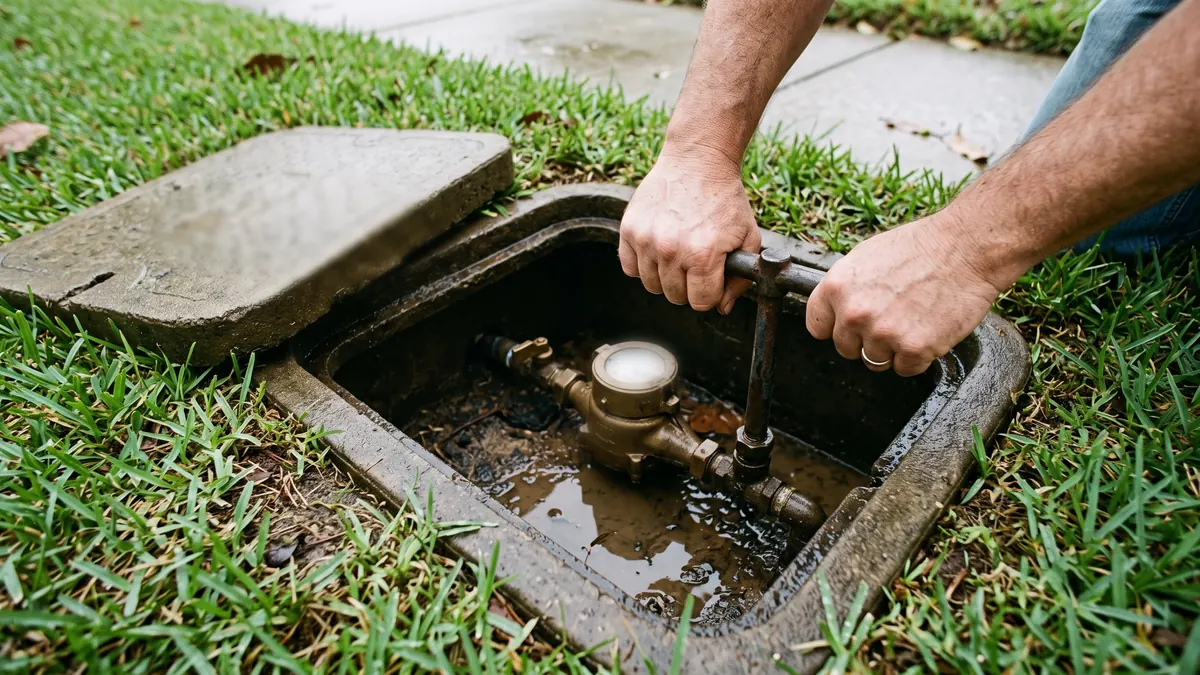
Water damage after a flood, a burst pipe, or a slow leak follows roughly the same order no matter what caused it: stop the water, protect yourself, document what happened, then hand off the parts that need real equipment. Some of that is on you. Some of it isn’t.
What you handle
These are the moves that don’t need any special training, just quick action.
- If water’s still running from a pipe, fixture, or appliance, stop it at the source. Most Friendswood homes built on a slab bring the main line up inside first, often right where it feeds the water heater or runs along a garage wall. Look for a lever or a round wheel-style handle on the pipe, roughly knee height. A quarter turn on a lever, or several full turns on a wheel handle, shuts the house off. If you can’t find it inside, or the trouble started outside the house, the backup lives at the meter, out near the curb or property line. That valve doesn’t turn by hand. It takes a meter key, a long-handled tool that reaches down to the valve and turns it a quarter turn. A hardware store nearby carries them. Keep one in a kitchen drawer, since pliers or a wrench won’t get a grip on it.
- Power comes off first if standing water is anywhere near an outlet, a cord, or the breaker panel itself.
- Take photos before you touch anything else in the room. Wide shots that show how high the water reached matter as much as close-ups of whatever’s clearly wrecked. If you can tell where the water actually came from, grab a shot of that too.
- If you can lift something without straining, move it off the wet carpet: rugs, loose items, chair and table legs.
- Wet materials don’t get long before mold turns into a real risk. The mold after water damage guide follows exactly how fast that risk builds, hour by hour.
What the pros take over
Past this point, the work needs real equipment, not a shop-vac and a mop. If water’s still spreading when you’re reading this, the emergency water removal page pieces together what a first visit actually looks like, tool by tool.
- Expect the standing water to leave first. Equipment built for real volume handles that part, well beyond anything a garage shop-vac could manage.
- Once the floor’s clear, a moisture reading shows how far the water actually traveled. It’s almost always farther than what you can see.
- After that, air movers and a dehumidifier take over, and they typically run for several days rather than just overnight, matched to the room and the materials that got wet.
What your insurer needs from you
A claim moves faster when you hand over a clean record instead of a vague story pieced together weeks later.
- Call your insurer or file online the same day you find the damage, if you’re able to.
- Write down what happened and when, plus every call you make about it afterward. That record becomes the backbone of your claim file.
- If more damage turns up once work starts, water behind a wall, something soaked under a cabinet, tell your insurer right away instead of waiting for a final bill to explain it.
How your policy actually treats what happened is its own question, one the homeowners insurance guide follows scenario by scenario.
A list beats adrenaline
Everything on this list assumes the water’s already stopped. If it isn’t, that’s step zero, before the photos, before the list, before anything else here. A call sorts that part out first, then everything above still works exactly as written. Adrenaline makes people skip steps or do them out of order. A list, even a short one, is what keeps that from happening when it matters most.
Common questions
Is filing an insurance claim worth it for a minor leak?
Not always. If the repair costs less than your deductible, filing usually doesn't help, since you'd cover it yourself anyway. For anything that touched more than one room, or a repair bigger than your deductible, filing is usually worth it.
Can normal life continue in the house while drying equipment runs?
Often, yes, especially if the damage stayed to one room or area. Noise and moved furniture are the main disruptions. If the air quality feels off, or the wet area is large, ask the company handling it whether staying makes sense in your case.
Should I turn off the breakers for the whole house?
Not usually the whole panel, just the circuits anywhere near standing water or a soaked wall. If you're not sure which breaker controls what, or the panel itself looks wet, that's a job for an electrician, not a guess.
Related pages
AC condensate overflow
Follow the drip back far enough, and most summer ceiling stains start at the AC, not the roof.
Learn more →Drying time
Carpet, drywall, wood, and concrete all dry on their own timeline, and knowing which is which changes what happens next.
Learn more →Frozen pipe guide
A frozen pipe bursts in predictable spots, the attic, an exterior wall, a hose bib, and each one needs different prep.
Learn more →Insurance coverage
Coverage comes down to two things: how fast the water showed up, and where it came from.
Learn more →Talk to a local pro now
We answer 24/7. One call gets a Friendswood crew moving on your water damage, with a free estimate and help with your insurance claim.
Emergency Line(832) 447-6199Free estimates. No obligation to hire.