
Emergency water removal in Friendswood
What happens in the first hour after water hits your floor decides how much of your house you get to keep.
Emergency Line(832) 447-619924/7 emergency line. Free estimates from local pros.
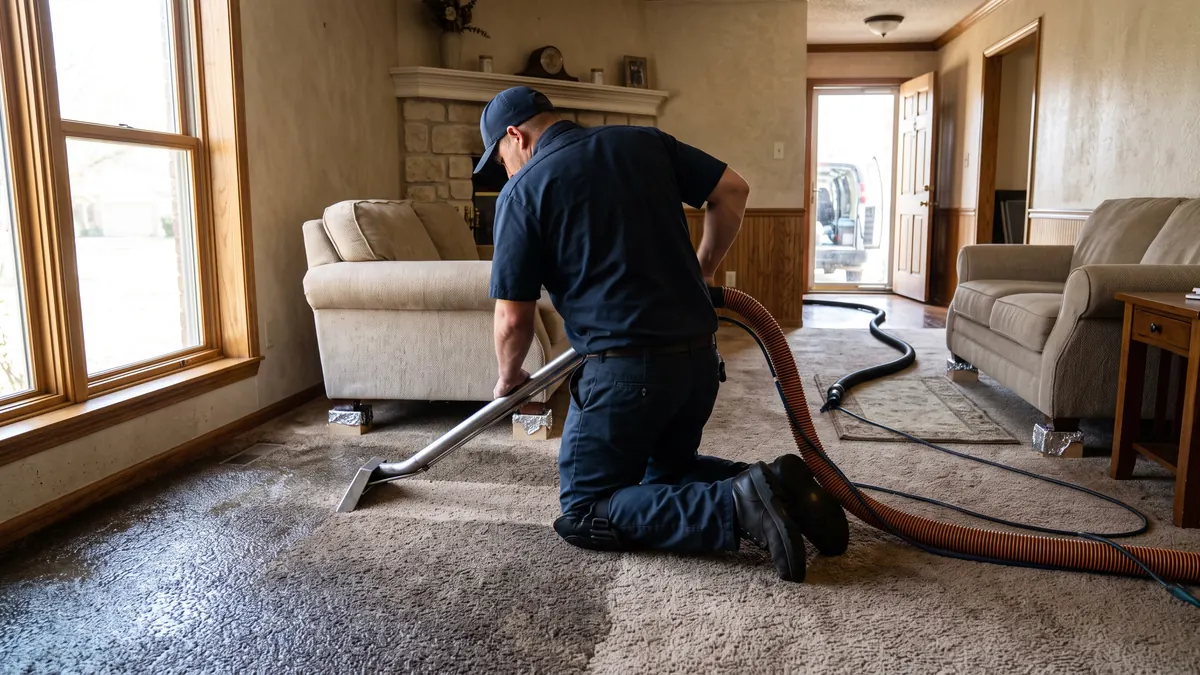
Emergency water removal means pulling standing water off your floors and out of the carpet pad before it soaks any deeper. It’s the first job on almost every water damage call, and which tool does the pulling matters more than most homeowners expect.
What a shop-vac leaves behind
A shop-vac lifts water sitting on top of tile or a sealed hardwood floor well enough. It struggles the moment water sinks into carpet, pad, or the gap behind a baseboard. A household vacuum only pulls a small volume with each pass across the floor. A truck-mounted extraction unit works on a different scale. It pulls far more water per pass, with enough suction to draw moisture back out of soaked padding instead of just skimming what sits on top. Run a shop-vac over the same wet carpet three or four times, and it still won’t match one real pass from a truck-mounted wand. That gap is exactly how much water is still sitting in your floor once the visible puddle looks gone.
The order the work follows
Extraction happens first. Nobody sets up drying equipment in a room that still has standing water in it. Once the floor’s clear, a moisture meter comes out next, checking walls, baseboards, and subfloor to map how far the water actually traveled, which is usually farther than it looks. Air movers and a dehumidifier go in last, sized to the room and the materials that got wet instead of guessed at.
Cut the power before you touch anything wet
Water and electricity sharing a room is a real hazard, not a scare tactic. Standing water anywhere near a plug, a cord, or the panel itself means that circuit gets cut first, before anything else happens. If the water’s still running from a pipe or fixture, get that stopped too. The what to do after water damage guide traces where that shutoff usually hides in a Friendswood house.
Photos before anything gets moved
Take pictures first. Don’t drag a box, run a fan, or mop a puddle until you’ve got the shots. Wide shots that show how high the water climbed matter as much as close-ups of whatever’s clearly ruined. Once furniture moves and the floor gets mopped, that record is gone, and it’s exactly the record an adjuster or an estimator ends up asking about later.
The pad remembers
Carpet pad holds onto water even after the carpet on top feels dry against your hand. That’s exactly what a shop-vac skips and a truck-mounted unit is built to reach. Left wet, that pad turns into the kind of material mold moves into fastest, and the window for that is shorter than most people guess. The mold after water damage guide traces the actual numbers.
What gets torn out and what stays becomes its own decision once the water’s gone, one the water damage repair page weighs once the floor’s had a chance to dry. Carpet, pad, and the layers underneath don’t dry at the same speed either, and the drying-time guide sizes each one up on its own.
Put the call on speaker and keep working. Snap the photos, check the meter, pull furniture off the wet carpet while you talk. The conversation doesn’t need your full attention. The person on the line just needs a feel for what’s wet and how long it’s been that way. Your hands don’t have to stop for the call to start.
Common questions
Does the phone actually get answered in the middle of the night?
Yes. Water damage doesn't keep business hours, and this line doesn't either. Someone picks up any hour, any day of the week. What happens after that call depends on which local company is available near you, not on the clock.
Is a shop-vac good enough on its own?
For a small spill on a hard floor, usually. Once water has soaked into carpet, pad, or behind a baseboard, a household vacuum can't pull enough volume to catch up with it. What's left behind keeps spreading long after the visible puddle is gone.
Roughly how long does everything take to dry?
It depends on the material, how long the water sat, and how humid the air's been. Carpet usually dries faster than a soaked subfloor or a wet wall cavity. The drying-time guide sizes up typical ranges for carpet, drywall, and flooring one at a time.
Related pages
Appliance leak cleanup
A leaking water heater or appliance line can soak a floor for days before anyone notices.
Learn more →Burst pipe cleanup
A burst pipe floods fast, and insurance usually treats it as sudden, accidental damage.
Learn more →Ceiling water damage
A ceiling stain tells you where to look before it tells you what to fix.
Learn more →Commercial water damage
For a business, the closed sign costs more than the water that caused it.
Learn more →Talk to a local pro now
We answer 24/7. One call gets a Friendswood crew moving on your water damage, with a free estimate and help with your insurance claim.
Emergency Line(832) 447-6199Free estimates. No obligation to hire.